

As the global demand for sustainable transportation intensifies, cities with busy coastal and river networks are turning their attention to maritime transit. Ferries play a crucial role in connecting urban hubs, moving millions of passengers every day. However, most ferries still operate on diesel engines, contributing to air pollution, greenhouse gas emissions, and noise. Zero-emission ferry routes are emerging as one of the most effective tools for decarbonising high-capacity electric public transport on water. As a result, many cities are reassessing their most active ferry routes to reduce emissions while maintaining high passenger capacity and reliability. Integrating ferries into wider electric mobility plans allows waterfront cities to address environmental challenges without disrupting essential transport links. Electric ferry pilot programs in Europe, from Norway and the Netherlands to Denmark and Portugal, are demonstrating that the question of how to electrify a ferry fleet is no longer one of feasibility but of planning and policy. Electrification offers a powerful solution to these environmental and operational challenges. The move toward electric-powered vessels represents more than a technological shift; it is a commitment to cleaner, smarter cities. For many urban centres, transforming the most trafficked ferry routes into zero-emission ferry routes could have a profound impact on public health and climate goals. Adopting green mobility is not just an environmental commitment; it is a strategy for long-term economic and social sustainability. By combining zero-emission ferry routes with land-based electric shuttle services, cities can create seamless, low-emission transport corridors that strengthen electric mobility ecosystems and reduce fossil fuel dependence across waterfront regions.
Why Electrify Ferries? Inside the Shift to Zero-Emission Ferry Routes
The transformation of a traditional combustion ferry service into a zero-emission electric ferry service plays a pivotal role in sustainable urban mobility planning. Fossil fuel-powered ferries are significant contributors to CO₂, nitrogen oxides, and particulate matter, especially in densely populated port cities. Unlike land-based transit, ferry systems have lagged behind in adopting electric technology, yet advances in battery capacity, charging infrastructure, and vessel design now make electrification both technically feasible and economically viable. Battery-electric ferry retrofit programs have made it possible to upgrade existing diesel vessels at a fraction of the cost of new builds, accelerating the shift to zero-emission ferry routes. For cities focused on sustainable mobility, electrifying ferry services represents a practical way to decarbonise high-capacity transport corridors that operate daily within urban environments. Electric public transport on water helps address emissions where road-based alternatives alone are insufficient, particularly in dense port cities where ferries are central to daily commuting.
Electric ferries provide several benefits:
- Zero tailpipe emissions, reducing pollution
- Lower operational costs from fuel and maintenance
- Quieter, smoother rides for passengers
How do electric ferries reduce urban air pollution?
Electric ferries reduce urban air pollution by eliminating tailpipe emissions of nitrogen oxides, sulphur dioxide, and particulate matter entirely. In port cities where ferries operate close to residential zones, replacing a single diesel vessel with a battery-electric alternative can measurably improve local air quality within months, a benefit difficult to replicate with road-based electrification alone.
Electric ferries provide several core benefits: Zero-emission ferry routes eliminate tailpipe pollution, directly improving air quality in waterfront communities.
lower operational costs from fuel and maintenance savings; quieter, smoother rides for passengers, with reduced underwater noise for marine life.
Compliance with environmental regulations is increasingly enforced by city and national governments. The European Green Deal, which aims to make Europe the first climate-neutral continent by 2050, is funded by a third of the €1.8 trillion NextGenerationEU plan and the EU budget. Electric ferry pilot programs in Europe are directly supported by these funding streams, allowing cities to launch zero-emission ferry routes without bearing the full upfront cost alone. These advantages make zero-emission ferry routes particularly attractive for port cities seeking to align public transport with climate targets while improving passenger experience. When paired with land-based electric shuttle services, ferry electrification supports broader electric public transport on water and across urban regions. Smart technology and real-time monitoring are now helping optimise energy use and scheduling along zero-emission ferry routes worldwide, and as data-driven systems evolve, electric mobility solutions in maritime transport are becoming more efficient, reliable, and scalable, reinforcing the role of electric ferries within long-term sustainable mobility strategies.
Hyke: The European Model of Maritime Innovation
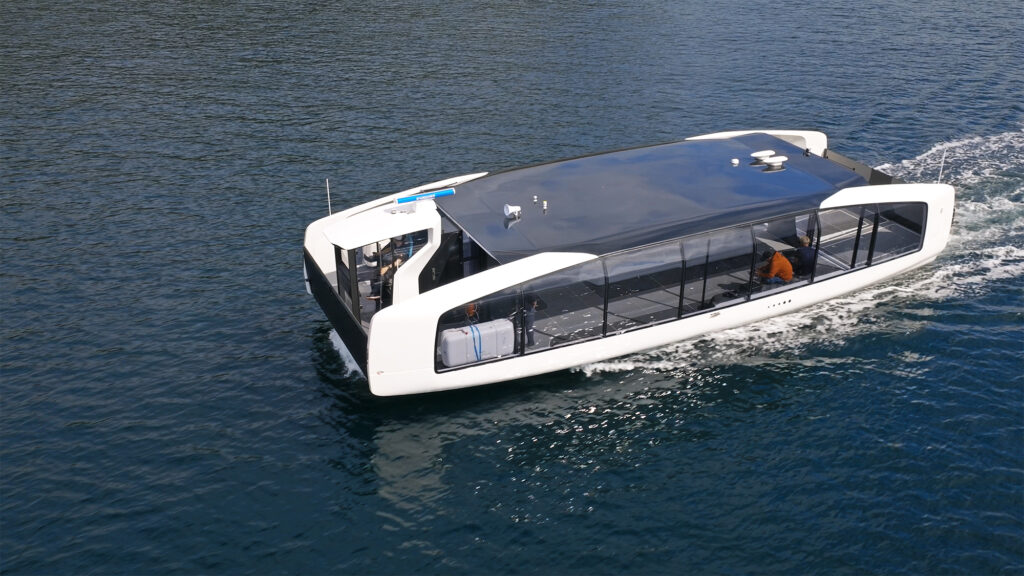
In this clean transport revolution, Hyke is setting a new standard for electric public transport on water in smart, modern cities. The company manufactures fully electric ferries designed for autonomy, with optional solar panel compatibility and integrated fast CCS charging infrastructure. These models are specifically tailored for short, high-frequency urban routes, making them ideal for waterfront cities such as Hong Kong, Istanbul, Rotterdam, Lisbon, and Copenhagen. Hyke’s F-15 Shuttle is one of Europe’s leading designs for zero-emission ferry routes, purpose-built to integrate into existing public transit fleets with minimal port infrastructure upgrades.
By supporting high-demand zero-emission ferry routes, Hyke’s vessels enable cities to transition critical maritime corridors toward electric mobility without compromising operational efficiency, allowing public transport authorities to expand sustainable mobility initiatives beyond land-based systems. By eliminating operational emissions and integrating seamlessly into existing transport ecosystems, Hyke ferries deliver both technological edge and environmental care.
More than a product, Hyke offers cities a proven, plug-and-play solution to fast-track their waterfront electrification goals. Explore Hyke’s urban mobility solutions to see how zero-emission ferry routes can be deployed in your city. When combined with electric shuttle connections on land, Hyke’s electric ferries help cities build cohesive electric mobility networks that improve accessibility while reducing environmental impact, reinforcing long-term sustainable mobility planning across urban waterfronts.
High-Impact Routes Leading the Way: Which Cities Are Leading Electric Ferry Adoption?
Several of the world’s most utilised ferry networks have either begun their electrification journey or are exploring pilot programs. These electric ferry pilot programs in Europe and beyond show which cities are leading electric ferry adoption, and how their approaches can serve as a global blueprint. These early adopters demonstrate how zero-emission ferry routes can serve as anchor projects for wider electric mobility transitions in dense metropolitan regions.
Norway, Singapore, Sydney, New York, and Istanbul are currently among the cities leading electric ferry adoption, with active fleets or advanced pilot programs already in operation. Fredrikstad, Norway, home of Hyke’s F-15 Shuttle, is widely cited as one of Europe’s most successful examples of a fully operational zero-emission ferry route integrated into a public transit network.
Staten Island Ferry – New York City, USA
Carrying over 70,000 passengers daily, this iconic service is essential for commuters. The city has already initiated a transition to hybrid-electric ferries, with a focus on reducing carbon emissions and improving cost efficiency. This shift highlights how electrification can be introduced incrementally along major ferry routes while maintaining service continuity and passenger capacity. Battery-electric ferry retrofit programs like New York’s are an effective way to ease cities into full fleet electrification without disrupting daily commuter flows.
Victoria Harbour – Hong Kong
Serving more than 20 million people each year, Victoria Harbour plays a vital role in transportation. Electrification plans are underway, supported by environmental agencies and local authorities, aiming to reduce maritime pollution in the harbour. For dense coastal cities, zero-emission ferry routes paired with electric mobility initiatives on land offer a powerful path toward sustainable mobility without increasing road congestion.
Sydney Ferries – Australia
Moving upwards to 14 million passengers annually, Sydney’s ferry system includes scenic and commuter routes across the harbour. The city recently introduced electric catamarans as part of a long-term effort to modernise its public water transport, showing how electric ferries can modernise public transport while improving passenger experience and reducing environmental impact.
Istanbul Ferries – Turkey
Bridging Europe and Asia, Istanbul’s ferries are a crucial transport artery. With increasing environmental awareness, Turkish officials are investing in sustainable marine technologies, including electric propulsion systems for their growing fleet.
Electrifying such high-demand ferry corridors supports sustainable mobility goals while reinforcing the role of ferries within multimodal electric transport systems.
Fredrikstad – Norway
Fredrikstad’s city ferries are loved by locals and visitors alike, transporting 1.5 million passengers in 2019, about 20 journeys for every resident of the city. Hyke aims to bring this ferry solution to the rest of the world. Since commencing regular operations in April 2024, the Hyke electric ferry shuttle has been fully operational in Fredrikstad as part of the Byferga fleet, an essential component of the local public transit system, transporting an average of 3,000 passengers per month during its first six months, earning excellent user feedback and being named category winner of the 2024 Gussie Award. Fredrikstad demonstrates that zero-emission ferry routes, when integrated into existing public transit networks, can achieve high ridership and operational reliability from day one, making it a leading reference point for how to electrify a ferry fleet at the city scale. This real-world deployment illustrates how electric shuttle services on water can operate reliably at scale, reinforcing electric mobility as a practical solution for everyday urban transport.
Vaporetto – Water buses in Venice
Vaporetto are public water buses of Venice; they are essential for navigating the city and its surrounding islands. The vaporetto is operated by ACTV, the Venetian public transport system. They are the main way to get around the city. It travels along the Grand Canal and connects different islands.
As historic cities like Venice explore sustainable mobility options, electric ferry routes offer a way to preserve urban heritage while reducing emissions and noise from daily transport operations.
Building a Blueprint for Electrification: How to Electrify a Ferry Fleet
Transitioning to electric-powered waterfront transit involves more than just swapping out vessels. Cities planning how to electrify a ferry fleet need a comprehensive blueprint that accounts for routes, infrastructure, policy, and crew, not just hardware.
Route Assessment
Not all ferry lines are equally suited to electrification. Ideal routes are typically short-distance and high-frequency, allowing batteries to charge at docks between trips. A full audit of route demands and fleet age helps determine the best candidates for conversion. Battery-electric ferry retrofit programs are most cost-effective on short urban routes where existing vessels can be upgraded rather than replaced. Carefully selecting which routes to electrify ensures that zero-emission ferry routes deliver consistent performance while supporting long-term sustainable mobility objectives.
Shore-Side Charging Infrastructure
Electric ferries require fast-charging stations at terminals or wireless charging technology integrated into docking systems. These investments need coordinated planning with port authorities and electricity providers to ensure grid stability.
Reliable charging infrastructure is a critical enabler of electric mobility, allowing electric ferry routes to operate on tight schedules without service disruption.
Policy and Incentives
Government support is vital. Grants, tax relief, and green bonds can encourage public and private operators to invest in electric vessels and infrastructure. In Europe in particular, electric ferry pilot programs are frequently co-funded through EU and national schemes that lower the financial barrier to entry. Strong policy frameworks accelerate sustainable mobility adoption by reducing financial barriers and encouraging investment in electric ferry and electric shuttle systems.
Crew Training & Maintenance Upgrades
Electric ferries need updated maintenance protocols and specialized technical knowledge. Investment in training programs ensures a smooth transition and safer operations.
Well-trained crews and modern maintenance practices strengthen electric mobility ecosystems, ensuring electric ferry routes remain reliable, safe, and efficient over time.
Challenges and Solutions
Despite rapid progress, electrifying the world’s busiest ferry routes presents complex challenges that go beyond simply replacing old vessels. Upgrading harbour infrastructure to support fast-charging systems requires public-private collaboration and significant capital investment upfront. Some older terminals lack grid access or sit in heritage zones, complicating construction and limiting large-scale retrofit options, while ferry operators must rework schedules to accommodate charging downtime during peak passenger hours. These constraints make it essential to prioritise zero-emission ferry routes that can deliver immediate impact while fitting within existing infrastructure and electric mobility plans.
Battery-electric ferry retrofit programs are often the most pragmatic first step for cities with limited terminal upgrade budgets. Battery supply chains also remain under pressure, and sustainable sourcing of lithium and rare earths must stay front-of-mind as fleets expand, but many of these hurdles are transitional. As electric mobility adoption increases across transport sectors, shared supply chains and standardisation are expected to reduce pressure and improve resilience for electric ferry and electric shuttle deployments. Battery technology is evolving rapidly and modular systems are improving both energy storage and charging efficiency, enabling more flexible zero-emission ferry routes that let operators maintain high-frequency services while strengthening long-term sustainable mobility strategies in waterfront cities.
The Future of Waterfront Transit
The shift toward zero-emission water transport is inevitable. By prioritising the busiest ferry routes, cities can achieve maximum impact in reducing pollution, improving public health, and creating resilient transport systems. Green mobility empowers citizens to move freely while contributing to cleaner cities and more liveable public spaces. As zero-emission ferry routes expand, they are becoming a cornerstone of electric mobility strategies that link waterfronts with wider urban transport networks; when combined with electric shuttle connections on land, these systems strengthen sustainable mobility while reducing pressure on congested road infrastructure. With the right infrastructure, policy support, and technological commitment, electrified ferry systems could soon become the norm rather than the exception. Ongoing electric ferry pilot programs in Europe are proving that the path from pilot to permanent fleet can be measured in years, not decades. This evolution positions electric public transport on water as a long-term solution for cities seeking scalable, low-emission transport options that support sustainable mobility goals across generations.
Find out why forward-thinking coastal cities are adopting Hyke’s electric ferries for smart, zero-emission ferry routes and clean urban water transport. By integrating zero-emission ferry routes into everyday public transport planning, cities can accelerate the transition toward cleaner, smarter, and more connected electric mobility ecosystems. Learn About Hyke Here.
By integrating electric ferry routes into everyday public transport planning, cities can accelerate the transition toward cleaner, smarter, and more connected electric mobility ecosystems.