

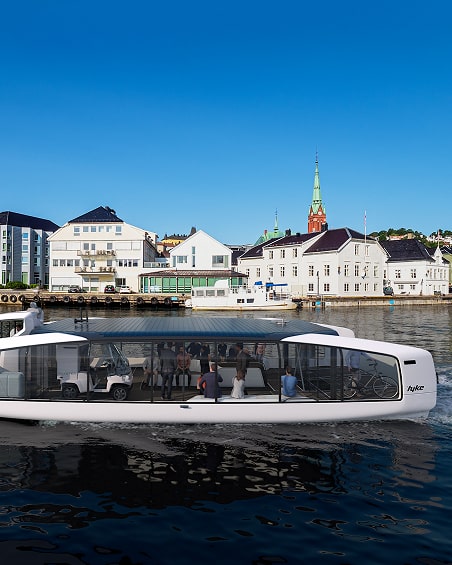
Cities are investing billions in smarter roads, smarter rails, and smarter buses. And yet, in many of the world’s most water-adjacent urban centres, one of the most efficient transit corridors available sits largely idle.
As urban populations grow and road networks reach capacity, cities are beginning to ask what a truly comprehensive public transit system looks like.
For any city built on a coastline, river delta, or fjord, the answer has to include the water.
This post explores how smart city mobility solutions are beginning to close that gap, and why electric passenger ferries are emerging as a serious, scalable component of urban public transit. Oslo offers the clearest blueprint of what’s possible when a city commits fully.
What Does Smart Mobility Actually Mean for Public Transit?
Smart mobility is often defined by what it optimises: journey time, emissions, passenger flow, and connectivity between modes. A genuinely smart transport network is one where every viable corridor is put to work. For waterfront cities, that definition should always include the fjord, the river, or the harbour.
The challenge has historically been integration. Ferry services have operated in parallel with land-based networks rather than as part of them, with different ticketing systems, separate apps, and limited real-time data. That fragmentation is what makes water transit feel secondary, not any inherent limitation of the mode itself.
The Underused Transit Corridor Hiding in Plain Sight
Water routes often run directly through the densest parts of a city. They bypass road congestion entirely. They move large volumes of passengers at low infrastructure cost relative to underground rail. And when powered by electric propulsion, they do all of this with near-zero direct emissions and significantly reduced noise.
The question for city planners is no longer whether electric boats can perform. That has been demonstrated clearly. The question is whether those vessels are woven into a city’s transit fabric in a way that makes them a genuine daily option, not an occasional alternative.
Oslo’s Blueprint: A City That Electrified the Fjord, Not Just the Streets
How Ruter Built a System-Wide Approach to Zero Emissions
Oslo’s transport authority, Ruter, is a good example on how to bring water transport into a city-wide zero-emission strategy. Rather than treating bus, tram, metro, and ferry as separate decarbonisation projects, Ruter embedded all modes within a single framework, which is the Zero Emission 2028 strategy.
The goal, adopted with broad cross-party political support, is to achieve 100% zero-emission public transport across both Oslo and the neighbouring Akershus region by 2028, part of a larger ambition to become the world’s first zero-emission capital by 2030.
Boat services were never treated as an afterthought within this plan. Of Ruter’s three boat services, two were already electrified, with the third being a work in progress. The result is a capital city where commuting across the fjord on a zero-emission vessel is simply part of the normal daily transit experience.
What Other Cities Can Take from Oslo’s Approach
Oslo did not arrive at its current position overnight. Ruter’s planning director has described it as a ten-year journey, beginning with a 2012 report and progressing through market research, strategy development, and a decade of procurement-led implementation.
The lesson for other cities is not to replicate Oslo’s exact solution, but to adopt its sequencing: political commitment, followed by clear targets, followed by systematic procurement reform.
The approach demonstrates that sustainable public transport doesn’t require revolutionary infrastructure. But, it requires clear goals, long-term contracts, and the willingness to treat water as a first-class transit mode.
Why Electric Boats Outperform Road Transit on Energy per Passenger
Water is a low-friction medium. Moving a vessel through it requires less energy per tonne-kilometre than moving road vehicles across tarmac. When that vessel carries 200 to 350 passengers at once, as Oslo’s island ferries do, the energy efficiency per passenger journey becomes compelling.
Oslo’s electric island ferries carry up to 350 passengers per crossing, significantly more than the 236-capacity vessels they replaced. This increase in capacity came alongside a shift to full battery-electric operation, meaning more people moved with less environmental cost per journey.
For cities exploring the future of sustainable transport, this matters. As grids become cleaner and battery density continues to improve, electric passenger ferries become an increasingly efficient option for high-demand urban corridors.
How Do Electric Passenger Ferries Integrate with Ticketing, Apps, and Scheduling?
This is where smart mobility becomes concrete. A ferry that runs on electricity but operates in isolation from the wider transit network is an improvement in environmental performance, not in passenger experience. True integration means a few specific things:
Single-ticket access: Passengers should be able to board a ferry using the same fare product they use on the bus or metro. Ruter’s model achieves this; fjord crossings are part of the standard transit pass, not a separate booking.
Real-time data: Ferry departures, capacity, and delays should appear in the same journey planning tools as buses and trains. When water transit is invisible in a city’s mobility apps, it effectively doesn’t exist for most commuters.
Schedule coordination: Ferry timetables should be designed around connection opportunities; a boat arriving at a pier should align with bus or tram departures within a short walk. This is standard practice in land-based transit planning and needs to become standard practice for water routes, too.
Designing for Integration: What Cities Need to Get Right
The shift to electric passenger ferries requires coordinated investment in port-side infrastructure.
Fast charging systems, grid connections capable of handling high-power demands, and quay designs that accommodate automated charging connections are all prerequisites for reliable operation.
Hyke vessels are built around the globally adopted Combined Charging System (CCS), the same fast-charging standard used by electric cars. This enables seamless use of existing EV charging infrastructure, eliminating the need for specialized marine charging systems.
By leveraging widely available networks, operators can deploy electric ferry shuttles more efficiently, reduce infrastructure costs, and scale operations faster, especially in urban environments where EV charging access continues to grow.
Cities don’t need to wait for perfect solutions; they need to begin the infrastructure planning in parallel with fleet procurement.
What Does a Smart City Mobility Solution Look Like on the Water?
The best smart city mobility solutions share a common characteristic: they treat the passenger’s end-to-end journey as the unit of design, not the individual mode.
A person commuting from a waterfront neighbourhood to a city-centre office should be able to plan, book, and travel across ferry, tram, and metro without touching a different system.
This requires open data standards, interoperable ticketing platforms, and transport authorities willing to treat ferry operators as equal partners in the network. It is not a technical challenge, but a governance and procurement challenge. Oslo has shown that it can be solved.
What the Fredrikstad Pilot Demonstrated
Hyke’s collaborative pilot with Fredrikstad Municipality, testing the historic ferry route between Bekkhus and Vaterland using the Hyke Shuttle 0001, demonstrated something important: that integrating electric ferries into existing municipal transport networks is operationally achievable with minimal disruption.
This is a recurring finding in cities that move from ambition to implementation. The barriers are rarely technical. They are institutional. The willingness to include water transport in multimodal planning from the outset, rather than retrofitting it later.
The Fredrikstad pilot, like Oslo’s Ruter strategy, points toward the same conclusion: the infrastructure, the technology, and the operational frameworks for electric passenger ferries as mainstream public transit already exist. What scales the impact is the decision to treat them as such.
Key Data: Oslo’s Electric Public Transport Progress
| Metric | Detail |
| Zero-emission target | 100% public transport by 2028 (Oslo + Akershus) |
| Boat services electrified | 2 of 3 routes fully electric; 3rd still in progress |
| CO₂ reduction from Nesodden electrification | ~70% of Ruter’s total boat transport CO₂ |
| Annual NOx reduction (Nesodden) | 20 tonnes, about 45% of total boat emissions |
| Annual CO₂ cut from express boat electrification | 2,600 tonnes per year |
| New island ferry capacity | 350 passengers per crossing (up from 236) |
| Oslo’s overarching climate target | 95% reduction in direct emissions vs 2009 by 2030 |
Conclusion
The cities that will lead on urban transport over the next two decades are the ones that define smart mobility broadly enough to include every viable corridor.
Electric passenger ferries are no longer an emerging technology. They are an operational one. Oslo has demonstrated that they can be fully integrated into a zero-emission public transport network, that passengers use it in large numbers, and that the infrastructure investment required is tractable. The challenge for other cities is not technical feasibility, but it is the willingness to include water in the conversation from the beginning.Hyke’s electric ferry shuttle is designed for exactly this kind of integration: zero-emission, autonomy-prepared, and built to work within the multimodal systems that modern cities are building. If you’re exploring how water transport can play a more meaningful role in your city’s transit network, we’d welcome the conversation.