

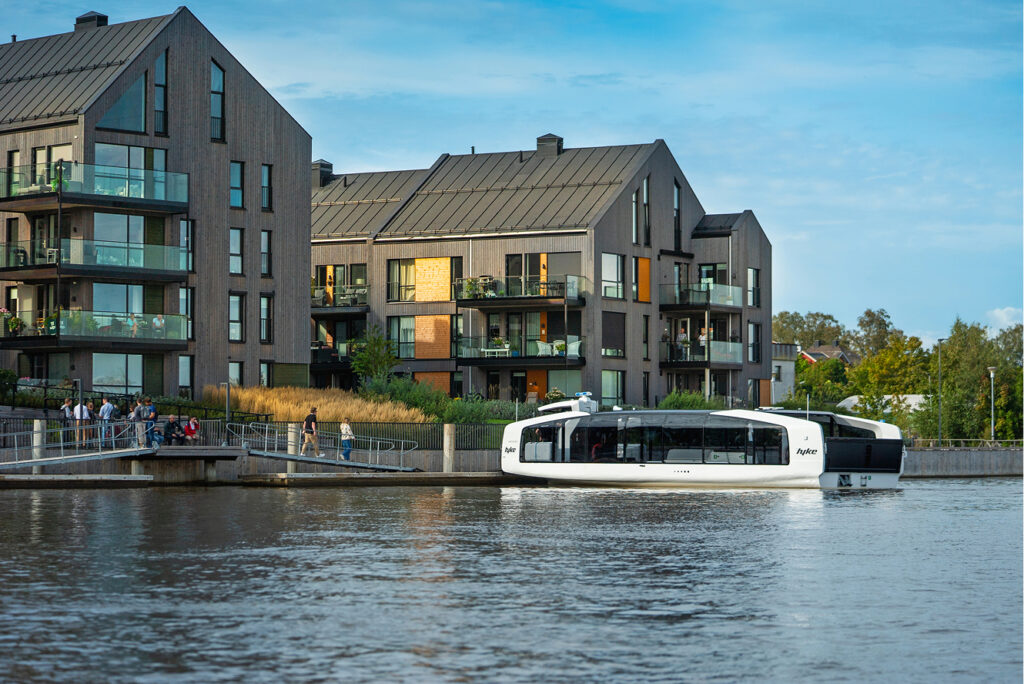
Copenhagen is widely regarded as one of the world’s most intelligently designed cities for mobility. Its cycling infrastructure is exceptional. Its metro and S-train networks are reliable. Its urban planning is coherent and forward-looking.
The question worth asking is whether an expanded electric ferry network can meaningfully redistribute urban mobility load. Copenhagen’s own experience with battery powered ferries offers a compelling starting point.
Why Copenhagen’s Radial Roads Are Under Pressure
Copenhagen’s road network is built around a radial design where major arterial roads converge toward the city centre from the surrounding municipalities. This structure is efficient for outward expansion but creates predictable pressure points at the core. Traffic data consistently shows that these radial arterial roads become substantially congested during morning and evening peak hours, despite the city’s well-developed public transport alternatives.
The city’s geography compounds the challenge. Copenhagen straddles water. The harbour separates significant residential and commercial zones from the centre, meaning commuter flows regularly funnel through a limited number of crossing points. When any one of those crossings slows, the effects propagate outward through the entire network.
What Does “Bridge Pressure” Actually Mean for City Transportation?
“Bridge pressure” is not simply about traffic jams on a particular span of road. It refers to a cascading effect: when bridge throughput is constrained, adjacent streets absorb overflow, public transport routes in the same corridor become crowded, and the reliability of the entire transport ecosystem in that zone degrades.
For a city like Copenhagen, which has invested substantially in cycling infrastructure and modal diversity, the persistent bottleneck at harbour crossings represents an inefficiency that cannot be resolved purely by adding lanes or re-phasing signals. The geometry of the crossing is fixed. The only scalable answer is to reduce the number of people who need to use the bridge at all.
This is where rethinking how cities organise public transport becomes essential, and where the water offers a credible alternative.
Why Waterways Are an Underused Asset in Urban Mobility Solutions
Most waterfront cities were built around their harbours. Over time, as road and rail infrastructure matured, the water became associated with logistics, leisure, and tourism rather than daily commuter movement. The result is a significant underuse of a natural transport corridor that runs through the heart of the city.
Copenhagen’s harbour is a case in point. The channel between Sjælland and Amager is a direct, unobstructed route. Traffic on the water is not subject to signal timing, lane closures, or congestion spillover from adjacent streets. A vessel crossing the harbour follows a fixed, predictable path at predictable intervals, precisely the conditions that make it attractive as a commuter service.
The practical argument for urban waterway transport is not romantic. It is operational. Water routes can carry passengers between points that road infrastructure connects only indirectly, reducing total journey distance and bypassing the congested zones around bridge approaches entirely.
How Does Water Transport Compare to Other Urban Mobility Solutions?
The comparison is not one of replacement but of complementarity. An electric ferry network does not compete with cycling infrastructure or the metro. It adds a parallel corridor, one that is largely insulated from surface-level disruption.
For commuters crossing between Amager and the city centre, or moving along the harbour between districts, a reliable ferry service offers a materially different journey: no bridge queuing, no signal delay, and, with a well-integrated ticketing system, no additional cost barrier. Studies on waterborne urban transport in Scandinavian contexts suggest that door-to-door travel time can be reduced significantly when water routes are properly integrated with cycling and pedestrian infrastructure at either end.
For a deeper look at how electric ferries and waterfront city development interact at the urban scale, the connection between transport planning and liveable city design is worth examining.
Copenhagen’s Proof of Concept
Copenhagen did not wait for a theoretical model. In 2020, the city’s public transport authority Movia completed the transition from a diesel-powered harbour fleet to a fully electric one, deploying five battery powered ferries across routes 991 and 992. The service operates across 11 stops, connecting Orientkaj in the north with Teglholmen in the south, zig-zagging across the harbour past Nyhavn, the Royal Library, Islands Brygge, and Refshaleøen.
The vessels carry up to 80 passengers each, with capacity for bicycles and accessibility provisions, making them genuinely multimodal rather than a standalone service. They run year-round, integrated within the standard public transport ticketing system at no additional fare.
The service is not an experiment. It is an operational, permanent component of Copenhagen’s public transport network. That is an important distinction. It confirms that battery powered ferries can perform reliably in a northern European urban environment across all seasons.
What Does the Emissions Data Show About Zero Emission Ferries?
The environmental results are measurable and significant. The shift to electric harbour buses reduced total particulate matter emissions across Copenhagen’s public transport sector by 66%, NOx by 10%, and CO₂ by 2.5%, and that is from seven vessels operating two routes. The proportional impact of a larger electric ferry network would be considerably greater.
These are not projections. They are audited outcomes from an operating fleet. For city planners evaluating the case for zero-emission ferries, Copenhagen’s harbour bus data provides a credible, real-world baseline rather than a modelled estimate.
This aligned with Copenhagen’s CPH 2025 Climate Plan and remains consistent with the city’s newer Climate Plan 2035 direction. Road traffic accounts for the majority of CO₂ emissions from Copenhagen’s public transport sector, and moving commuters from congested roads to the water addresses that at source.
Can Battery-Powered Ferries Replace Bridge Crossings for Commuters?
Replace is the wrong framing. Supplement is more accurate and more achievable. The goal is not to redirect every bridge user onto a ferry. It is to give a meaningful proportion of commuters a viable alternative, reducing peak-hour demand at bridge approaches by enough to improve flow for everyone remaining on the road.
Even a modest redistribution of commuter trips from road to water can have a disproportionate effect on congestion. Transport networks are non-linear systems: reducing volume by 10–15% at a bottleneck point can improve throughput by significantly more than that percentage. Crossing points are precisely the kind of constraint where incremental capacity relief delivers outsized network-wide benefit.
An urban electric ferry network operating at regular frequencies, 10 to 15 minute intervals during peak periods, provides the predictability that commuters require for it to function as a genuine alternative rather than an occasional option.
How Do Zero Emission Ferries Integrate with Existing Public Transport?
Integration is the decisive factor. A ferry service that operates in isolation, with separate ticketing and no physical connection to cycling or metro infrastructure at its stops, will attract leisure passengers but not committed commuters.
The Copenhagen model addresses this directly: harbour buses operate on standard Movia tickets, and key stops are positioned to connect with both cycling routes and other public transport links.
Scaling this model means investing in the stop infrastructure as much as the vessels themselves. Covered bicycle storage, step-free access, and real-time schedule integration with metro and S-train information are what convert an interesting service into a reliable daily commuter option. The vessel is the visible element of the electric ferry network, but the stop is where the modal integration actually happens.
For a broader view of how these considerations fit within the future of sustainable transport in urban cities, the relationship between waterborne and land-based transport planning is increasingly recognised as a key lever for cities facing surface congestion.
What Can Other Waterfront Cities Learn From Copenhagen?
Copenhagen’s experience points to a straightforward principle: start with what is operationally achievable and build from there. The harbour bus network began with a focused set of routes serving a specific corridor, the harbour crossing between Amager and the city centre, and proved the model before expanding.
That sequencing matters. Cities do not need to design a complete electric ferry network before beginning. They need to identify the one or two corridors where road and bridge pressure is most acute and where waterway geography provides a credible alternative. The economics of battery powered ferries at this scale are demonstrably viable. The environmental outcomes are measurable. The integration model exists.
What Copenhagen ultimately demonstrates is that an electric ferry network is not a speculative intervention. It is an implementable component of a well-designed urban transport system, one that addresses congestion, emissions, and public space simultaneously.
Conclusion
Urban bridges and road networks were not designed for the commuter volumes they now carry. In most waterfront cities, the physical constraints of those crossings have become a limiting factor on the city’s mobility as a whole.
Zero emission ferries offer a practical response, not by replacing bridges, but by giving a meaningful share of commuters a direct, reliable, clean alternative across the water. Copenhagen has demonstrated that battery powered ferries can operate year-round as an integrated part of a major city’s public transport network, delivering measurable emissions reductions alongside genuine mobility value.
The question for other cities is not whether it works. Copenhagen has answered that. The question is whether the route design, stop infrastructure, and institutional alignment are in place to make it work for them.
Ready to explore what an electric ferry solution could look like for your city?
Visit the Hyke Shuttle product page to see how Hyke’s zero-emission, autonomy-ready ferry is designed for exactly these urban mobility challenges, or get in touch with the Hyke team to discuss your city’s waterway potential