
Norwegian marine tech company’s new Hyke F-15 Norwegian marine tech company’s new Hyke F-15 vessels combine Scandinavian luxury at sea with revolutionary efficiency. Gliding through the water using power equivalent to just five household hair dryers, the Hyke F-15 Business and Lounge merges luxurious interiors with best-in-class operational economy, heralding a new era of urban transport.
The first vessels are currently being built in Norway.
OSLO, NORWAY – 23rd November 2026
Norwegian electric ferry manufacturer Hyke has unveiled the F-15 range of vessels in two versions: Business and Lounge. Designed for executive transfers, luxury resorts, sightseeing and private charters, the fully electric vessels combine premium passenger experiences with exceptionally low energy consumption, lightweight construction and autonomous-ready technology.
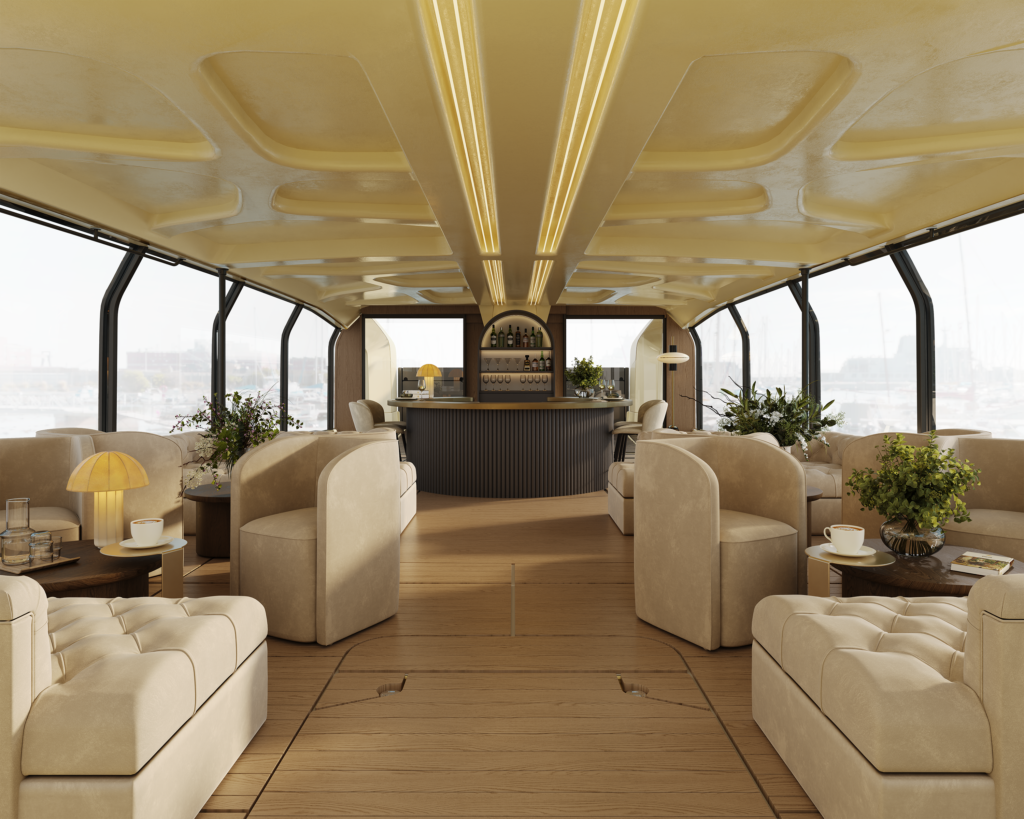
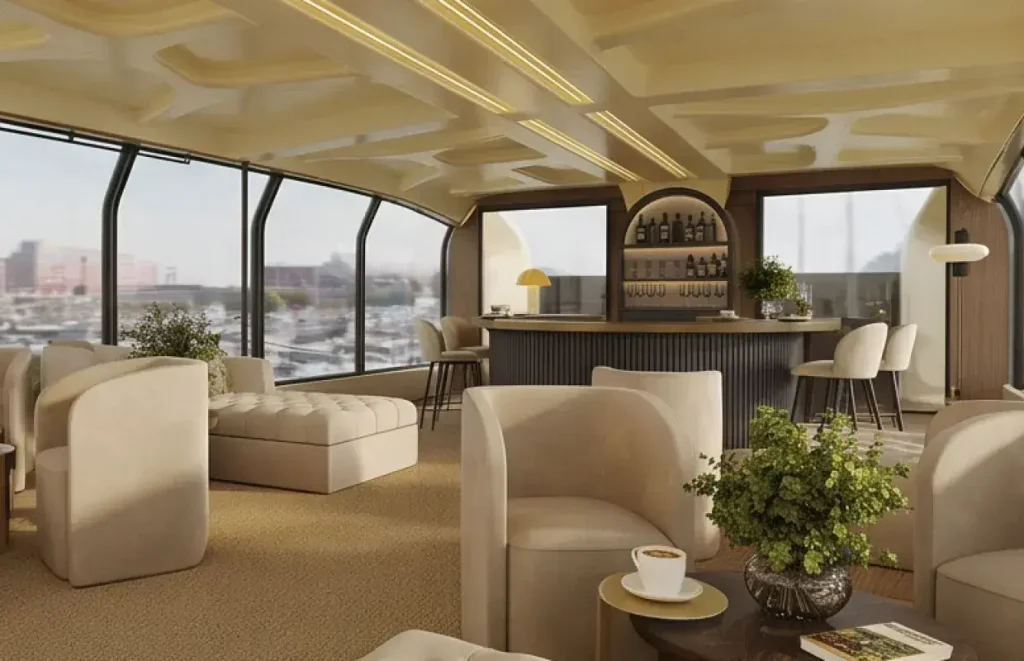
The two new configurations bring Scandinavian design to a compact, ultra-efficient electric ferry platform. Both feature customisable interiors that can be tailored to different operators, passenger requirements and brands.
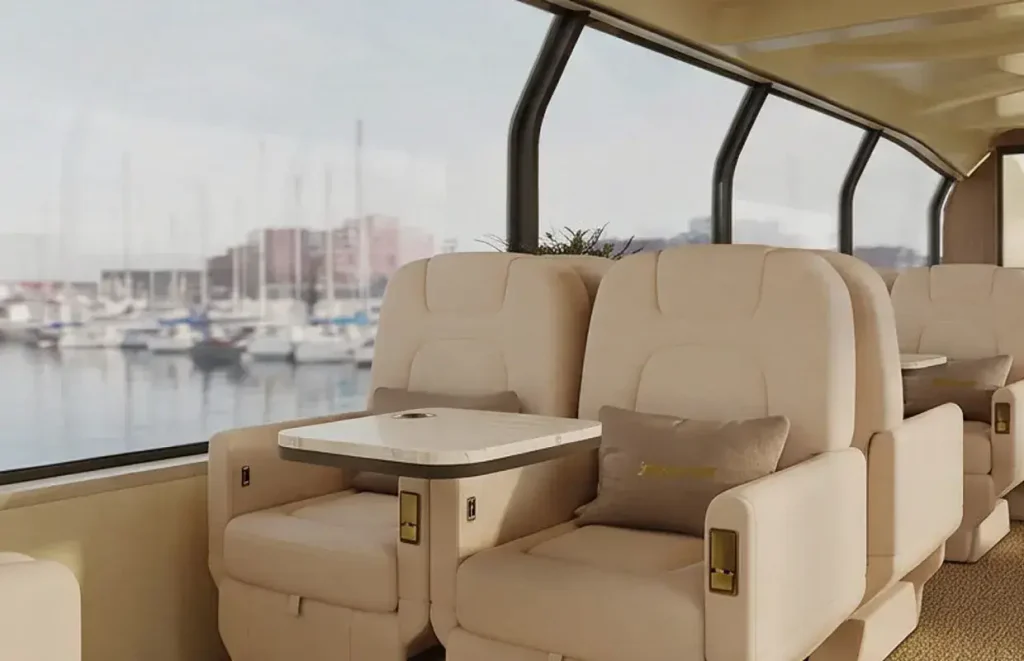
F-15 Business is designed for executive transfers, corporate mobility, private groups and premium passenger services. Its interior prioritises comfort, personal space and a refined atmosphere, turning journeys between business districts, airports and waterfront destinations into a premium travel experience.
F-15 Lounge focuses on hospitality, leisure and tourism. With a relaxed onboard environment and flexible seating arrangements, it offers hotels, luxury resorts, sightseeing operators and private charter companies a way to make the journey itself part of the experience.
Unlike conventional passenger vessels, which are often designed and built for a single purpose, the new Business and Lounge share the same modular platform as Hyke’s proven F-15 Shuttle, which can carry up to 50 passengers.
This allows operators to create distinctly different passenger experiences without the cost and complexity of developing entirely bespoke vessels.
The power of five hair dryers
What truly sets the F-15 apart is its remarkable energy efficiency.
At service speed, the vessel’s propulsion system requires approximately the same power as five household hair dryers.
This efficiency comes from lightweight construction, an optimised hull and advanced electric propulsion technology, dramatically reducing energy requirements compared with conventional passenger vessels.
This translates into dramatically lower operating costs for waterborne transport, addressing one of the main reasons why waterways remain underutilised for urban mobility.
“From airport transfers to inner-city transport, the shortest route between communities is often over water. With the Hyke F-15 Business and Lounge, we can dramatically reduce operating costs while offering a luxury travel experience unlike any other. Quiet, comfortable and entirely emission-free”1
Halvor Vislie, CEO of Hyke.
The F-15 also uses the CCS charging standard familiar from electric cars, allowing compatible charging equipment to be used rather than relying exclusively on bespoke, marine infrastructure, meaning the vessels can be quickly be deployed without costly infrastrcuture upgrades. Through its partnership with Aqua superPower, Hyke is also working to simplify the development of electric ferry networks by combining vessel technology, charging infrastructure and route planning.
Optional integrated solar panels provide an additional source of onboard electricity, while an autonomous-ready architecture prepares the vessels for future developments in marine automation.
Challenging conventional ferry economics
The new Business and Lounge vessels are part of Hyke’s broader ambition to challenge how passenger vessels are designed, built and operated.
Across the world, cities and waterfront destinations are surrounded by waterways that remain largely underused for passenger transport. Meanwhile, roads are congested, infrastructure is expensive and conventional ferry services can be costly to operate.
Traditional passenger vessels are often large, energy-intensive and purpose-built for specific routes or applications. Their high operating costs can make frequent services difficult to justify commercially, particularly where passenger demand varies throughout the day.
Hyke’s approach is different. By combining smaller, highly efficient vessels with modular construction, Hyke aims to make water transport more flexible, affordable and commercially viable.
Rather than relying solely on large vessels designed around peak demand, operators can deploy multiple smaller ferries and, where operational conditions permit, allocate capacity between routes as demand changes.
For cities, this creates opportunities to use existing waterways to connect destinations without building new roads, bridges or tunnels. For resorts and waterfront developments, it offers an energy-efficient alternative to conventional diesel-powered boats.
“We founded Hyke to challenge conventional thinking about maritime transport,”
“We wanted to create vessels that are exceptionally energy-efficient, practical to manufacture and commercially viable to operate.”
“With Business and Lounge, we’re demonstrating how the same platform can serve very different markets. Whether it’s commuters, executives or resort guests, operators can create an experience tailored to their customers without starting from scratch with a new vessel.”
Halvor Vislie, CEO of Hyke.
Turning transport into part of the experience
For waterfront destinations, the journey itself can become part of the attraction.
A resort transfer becomes a memorable arrival. A harbour crossing connects business districts without adding road traffic. A sightseeing journey offers visitors a new perspective on a city, without the noise and emissions of conventional diesel-powered vessels.
The launch follows growing interest in premium electric water transport, particularly in the Middle East, where waterfront developments, resorts and business destinations are creating new opportunities for passenger mobility.
Hyke recently strengthened its regional profile by winning the Most Promising Start-Up Award at the 2026 Autonomous e-Mobility Forum in Doha, Qatar.
Proven technology, new possibilities
While Business and Lounge are new configurations, the underlying F-15 platform has already demonstrated its capabilities in everyday public transport.
During a 14-month pilot in Fredrikstad, Norway, the F-15 Shuttle carried more than 41,000 passengers, achieving a satisfaction score of 4.72 out of 5. The project also reported up to 88% lower energy consumption per passenger-kilometre compared with the diesel ferry benchmarks assessed.
Hyke is already expanding beyond municipal transport. In Norway, Rødne and Viking Adventure have invested in an F-15 Shuttle through their joint venture, Cityboat, for tourism services around Haugesund. The new vessel is currently under construction in Norway, with delivery expected by the end of 2026. This further demonstrates the versatility of the F-15 platform across public transport and tourism.
The company has received international recognition, including being named one of TIME’s Best Inventions of 2022, winning the 2024 Gussies Award for Excellence in Electric Commercial Passenger Vessels in Operation and receiving the Most Promising Start-Up Award at the 2026 Autonomous e-Mobility Forum in Qatar.
With F-15 Business and Lounge, Hyke is extending its proven electric ferry platform into premium travel and hospitality, combining luxury passenger experiences with the ultra-low energy consumption and operational flexibility at the heart of its original design.
Media contact

Charles Pembroke-Birss
Vice President of Sales, Hyke
charles@hyke.no
+47 47 96 64 38