

Dhaka is one of the most congested cities on earth, yet a long ribbon of water already threads through some of its busiest districts. From Karwan Bazar in the west, the connected lakes and channels of Hatirjheel run east and then north toward Rampura, Badda, and the Gulshan–Baridhara area, passing homes, offices, hospitals, and universities along the way. Much of this corridor is underused, and it is not yet navigable as one continuous route. But it is not starting from zero: the Hatirjheel water taxi service has carried commuters across part of this waterway for years, showing that people will happily swap a gridlocked road for a calm ride on the water. This article explores how frequent, fully electric ferries could turn that fragment into a dependable transport corridor, helping commuters avoid the city’s gridlocked roads for suitable journeys. It is a possibility worth examining, not a plan that has been approved or built.
Why Is Dhaka Traffic So Congested?
Dhaka’s congestion is severe by any measure. A widely cited BUET study found average traffic speed on the city’s roads had fallen to about 4.8 kilometres per hour, barely faster than walking and down from around 21 km/h roughly fifteen years earlier. The cost of that gridlock has been estimated in the billions of dollars a year in lost productivity and wasted fuel.
The causes are structural. Dhaka’s two city corporations are home to more than 10 million people, within a wider metropolitan area of around 20 million, packed into a small land area with a road network that never kept pace. Offices, schools, and hospitals cluster in the centre, so millions criss-cross the city each day, competing for space with buses, rickshaws, cars, and motorcycles. Building more roads and flyovers has not reversed the trend. That is exactly why an underused water corridor running through the middle of the city deserves a second look.
A Transport Corridor Hiding In Plain Sight
The waterway in question is not a river. It is the connected, or potentially connectable, system of urban lakes and channels running roughly southwest to northeast: from the BFDC/Hatirjheel ferry ghat at Karwan Bazar, through Hatirjheel and Rampura, north through Badda, and on toward the Gulshan–Baridhara lakes and the Notun Bazar and Evercare Hospital area. It is a separate opportunity from the Buriganga, Turag, Balu, or Shitalakkhya rivers.
What makes this axis interesting for Dhaka waterway transport is where it goes. The corridor passes close to dense residential neighbourhoods, major employment centres, shopping districts, and educational institutions. A commuter who today crawls along the parallel roads for an hour could, in principle, glide along the same line by boat. The water is already there; the question is whether it can be connected and served properly.
The Hatirjheel Water Taxi Already Shows People Will Use The Water
The strongest evidence that this corridor has potential is that part of it already works. The Hatirjheel water taxi service launched in 2016 under the Hatirjheel Integrated Development Project and is overseen by RAJUK, the city’s development authority. It runs between jetties at Karwan Bazar/BFDC, Rampura, Badda, Police Plaza, and Gulshan/Gudaraghat, the very districts a longer corridor would serve, and Hatirjheel’s water taxis have quietly become part of some daily commutes.
Ridership tells the story. Published estimates place daily use in the tens of thousands, with one 2025 count putting it at around 20,000 passengers a day. Riders describe the trip as calmer and more predictable than the roads. Yet the service has also proved fragile: it has been interrupted by operator disputes and, more tellingly, by diesel shortages that forced operators to cut trips and warn of a possible shutdown. That dependence on diesel is both a weakness of the current service and a clue to what a better one might look like.
Can Water Taxis Solve Dhaka’s Traffic Problem?
Not on their own, and it would be wrong to promise otherwise. Water taxis cannot replace Dhaka’s buses, metro, and roads. The waterway reaches only part of the city, and most journeys will still begin and end on land. Transport specialists who have studied the corridor make the same point: a water service works best as a complement to other modes, carrying the share of trips that happen to run along its axis.
What water taxis can do is take real pressure off specific, heavily congested corridors. For someone travelling between, say, Badda and Karwan Bazar, a frequent boat that skips the roads entirely can turn an unpredictable hour into a short, reliable trip. So the honest answer is that water taxis are not a cure for Dhaka’s traffic, but they can be a genuinely useful part of the mix, especially if the corridor is connected end to end and the boats are dependable. Today’s diesel water taxis are neither.
What A Connected Hatirjheel Water Taxi Corridor Could Make Possible
Today the Hatirjheel water taxi operates on only a short stretch, a few kilometres between the FDC, Rampura, and Badda areas. The northern and southern sections are not one uninterrupted route: boats cannot currently pass into the Gulshan and Baridhara lakes because several road crossings sit too low over the water.
Closing that gap is the key to the whole idea. A proposed Gulshan–Baridhara waterway connection has been discussed publicly for years; Dhaka North City Corporation put forward a plan to turn several low culverts into bridges and to rebuild one road bridge higher so that boats could reach Baridhara. This is a proposed or developing connection, not a finished project. Creating a continuous ferry corridor would require one or more obstructing road crossings or low culverts to be replaced, raised, or re-engineered, subject to government approval and detailed technical assessment.
If that Gulshan–Baridhara waterway connection were made, the payoff could be substantial: a frequent southwest-to-northeast service running the length of the corridor, supplemented by short cross-lake hops between neighbourhoods that today sit only a few hundred metres apart across the water but a long detour apart by road. An electric ferry corridor in Dhaka could also connect cleanly with buses, walking routes, and the metro, so the boat becomes one dependable leg of a longer journey rather than a novelty. This is a future possibility to explore, not a confirmed government plan or a Hyke project.
Why Fully Electric Ferries Fit Dhaka’s Central Lakes
This is where fully electric vessels, rather than hybrids, make particular sense. On a sheltered urban lake, a battery-electric ferry runs quietly, with no exhaust and no diesel fumes drifting over the water or the neighbourhoods beside it. It produces zero direct operational emissions while running, which matters on a waterway that doubles as public space and, in the case of Hatirjheel, has been described in court as one of the city’s few green lungs. For Dhaka waterway transport to be taken seriously as everyday mobility, the boats need to be clean, quiet, and reliable, and electric propulsion delivers on all three.
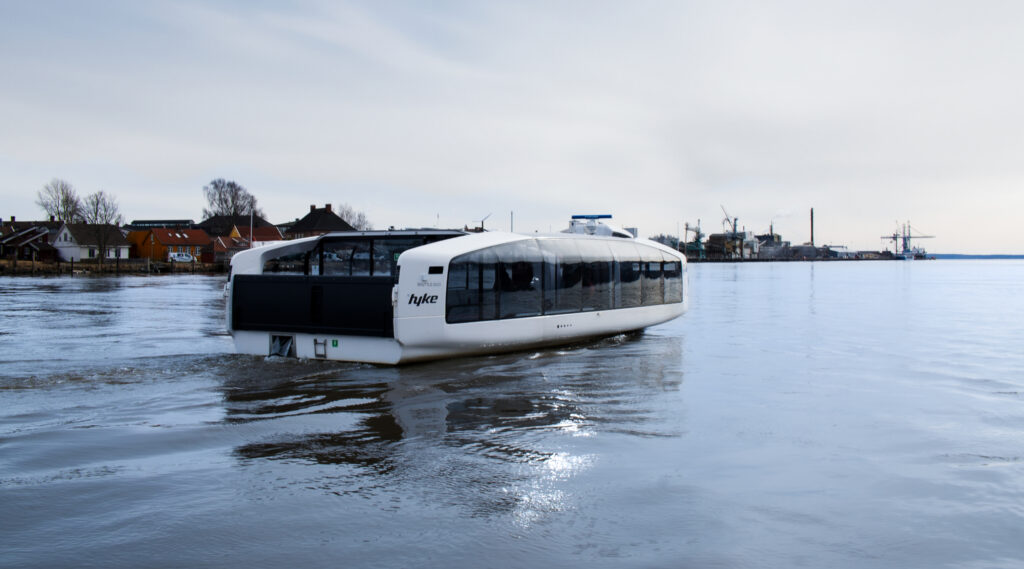
The practical fit is just as strong. Electric ferries are manoeuvrable and can be designed for shallow, calm water. They can charge overnight and top up during the day, and they can work with relatively simple floating landing points rather than heavy infrastructure. A clean electric ferry corridor in Dhaka would also address the current service’s biggest vulnerability, its reliance on diesel supply, by drawing on the electricity grid instead. Hyke’s own experience is relevant here: its fully electric F-15 Shuttle spent 14 months in daily public service in Fredrikstad, Norway, carrying more than 41,000 passengers while using far less energy than a comparable diesel boat. The vessels are fully electric, and the precise configuration for Dhaka would depend on a route survey. This is where a purpose-built approach, such as Hyke’s fully electric passenger shuttle, fits the brief.
What Must Happen First
An honest assessment has to acknowledge how much stands between today’s fragmented service and a working corridor. The first requirement is physical: creating one continuous route would mean replacing, raising, or re-engineering the obstructing road crossings and low culverts, subject to government approval and detailed technical assessment. Alongside that, parts of the corridor may need dredging or water-level management to stay navigable through the year, and the lakes’ well-documented pollution and encroachment would have to be tackled so the water is safe and pleasant to travel on.
The rest is the ordinary groundwork of good public transport. Landing points need to be safe, weather-protected, step-free, and easy to reach on foot, with clean links to buses, rickshaws, and walking routes. A fully electric fleet needs dependable charging at the right terminals and enough local electrical capacity to support it. And the vessels would require local passenger-vessel certification, with the whole service planned as an integrated part of the city’s transport network rather than a stand-alone attraction. None of this is trivial, but none of it is unprecedented either.
Conclusion
Dhaka does not need to conjure a transport corridor out of nothing. The water is already there, threading through exactly the districts where people most need an alternative to the roads, and Hatirjheel’s water taxis have already shown, in miniature, that commuters will use it. The opportunity is to connect the corridor properly, replace ageing diesel boats with fully electric ferries that produce zero direct operational emissions, and fold the service into the wider network so it becomes dependable rather than occasional.
That will take a proposed Gulshan–Baridhara waterway connection, cleaner water, better jetties, and careful planning, all subject to approvals and technical study. But the prize, a calm, clean electric ferry corridor in Dhaka that turns the central lakes into everyday transport, is worth the effort. The Hatirjheel water taxi has already proved the appetite is there. Hyke’s urban mobility solutions are built around exactly this idea of making the most of the water a city already has, and for Dhaka, the sensible next step is a proper route survey to test what the corridor could become.