
Lagos is a city built on water. Its islands, creeks, and the vast Lagos Lagoon wrap around neighbourhoods, business districts, and transport hubs, and yet water carries less than one percent of everyday journeys. Most of the roughly 22 to 23 million people in the wider metropolitan area travel by road, where congestion is punishing: the World Bank has reported that a Lagos commuter can spend on the order of four hours a day in traffic, time a water network could help take off the city’s overloaded roads. Omi Eko Lagos is designed to change that. The officially announced Lagos State programme aims to turn the city’s waterways into an organised, fully electric ferry network that complements, rather than replaces, the Metro, bus rapid transit, and existing bus services. This article looks at what the programme is set to deliver, why fully electric vessels suit the task, and what will determine whether it succeeds, drawing only on the publicly published details.
The Scale Of Lagos’s Mobility Challenge
Lagos is one of Africa’s largest urban areas, and its growth has outpaced its roads. The World Bank has documented how heavily the city leans on road transport and how much time residents lose to congestion, with commuters averaging around four hours a day in traffic. For a working population that size, those lost hours translate into lost income, strained health, and a drag on the wider economy.
Roads alone cannot absorb the demand. New flyovers and bus lanes help, but the sheer number of people and vehicles keeps outstripping capacity. That is what makes the water so attractive: it is a parallel network that already exists, running past many of the places people most need to reach.
Lagos Waterways: A Public Transport Network Hiding In Plain Sight
Lagos Lagoon and the city’s creeks already connect islands, mainland communities, employment centres, and transport hubs. Many trips that take hours by road, weaving across a handful of congested bridges, would be far shorter in a straight line across the water. Limited ferry services have long hinted at the appeal, carrying passengers between points such as Ikorodu and the island business districts in a fraction of the road time.
The gap has never been the water itself; it has been organisation. Until now, Lagos waterways public transport has been fragmented, under-equipped, and treated as a niche option rather than a dependable system. Turning it into a genuine network, with reliable vessels, proper terminals, and integrated ticketing, is exactly the gap the new programme sets out to fill.
What is The Omi Eko Project?
Omi Eko, which means “Water of Lagos,” is the officially announced Lagos State programme to modernise waterborne public transport. It is implemented by the Lagos State Waterways Authority and backed by a consortium of European partners, with total financing of around €410 million: a €170 million loan from the European Investment Bank, a €130 million loan from the French Development Agency, and a €60 million EU grant.
The Lagos electric ferry project is deliberately far more than a boat purchase. It covers 15 structured ferry routes spanning roughly 140 kilometres, 25 upgraded or expanded terminals, dredged and marked channels, charging infrastructure, maintenance facilities, and intelligent transport systems such as ticketing and vessel tracking. It is also designed to plug into the rest of the city’s transport, integrating with the Metro, bus rapid transit, and last-mile services, including Cowry Card ticketing. In other words, Omi Eko Lagos is being built as a complete transport system, not a fleet in isolation.
How Many Ferries Will Omi Eko Have?
According to the published figures, the programme will introduce 75 state-of-the-art fully electric vessels, each capable of carrying up to 440 passengers. Those 75 electric ferries will serve the 15 routes across roughly 140 kilometres of waterways, calling at the 25 terminals the programme is upgrading or building.
The ambition behind the numbers is the more important point. Lagos aims to lift water transport’s share of city journeys from under one percent today to as much as eight percent by 2032, in line with the state’s transport master plan. Reaching that would make the Omi Eko electric ferry network a mainstream part of how Lagos moves, rather than a pilot at the margins.
Why Fully Electric Ferries Matter For Omi Eko Lagos
Choosing fully electric vessels is central to what Omi Eko Lagos is trying to achieve. Electric ferries produce zero direct emissions while operating, which keeps exhaust out of the lagoon air and reduces the risk of fuel and oil pollution in the water, a genuine concern on a waterway that communities live beside and depend on. They are quieter, with less engine noise and vibration, which makes the ride more comfortable and the waterfront more liveable.
There are practical gains too. Matched properly to their routes, electric ferries can use less energy than diesel equivalents, and their smooth, predictable operation supports the dependable timetables a public network needs. Just as importantly, a clean fleet connects waterfront communities to the wider transport system without adding to the city’s air-quality burden. The aim of a Lagos electric ferry project on this scale is not only cleaner boats but a better everyday experience for the people who ride them.
Different Routes Require Different Vessels
One of the most important realities of the programme is that Lagos does not have a single operating environment. Some routes are short and sheltered, crossing calm, protected water; others are longer and more exposed, with greater wind, wake, and wave conditions. Passenger demand, distance, cruising speed, and charging opportunities vary from route to route as well.
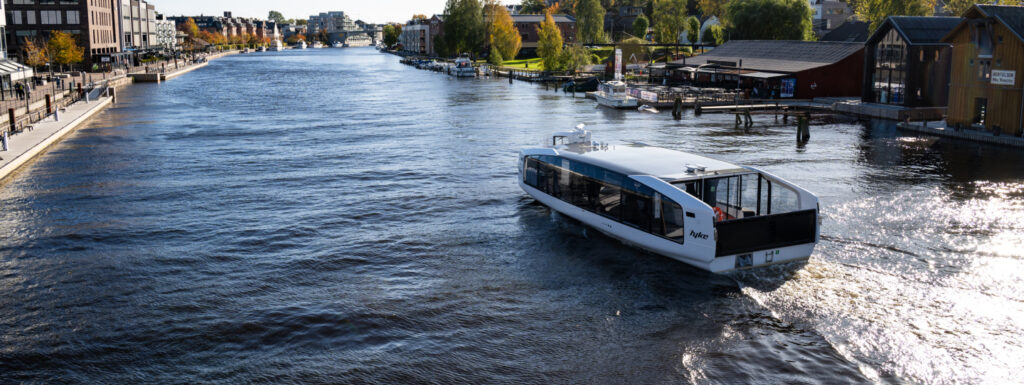
That argues for a route-matched fleet rather than one vessel design stretched across all 15 routes. Smaller, highly efficient electric ferries may suit short crossings, feeder links, and protected-water routes, while larger vessels may be needed on high-capacity or more exposed services. This is the context in which Hyke has explored how its fully electric platform could contribute. It is worth being clear about the limits of that: Hyke has not been publicly selected as an Omi Eko vessel supplier, and the credible role for a compact, efficient design like Hyke’s fully electric passenger shuttle would be on appropriate route categories, subject to a proper route survey and the tender’s technical requirements. Hyke’s current shuttle is considerably smaller than the maximum vessel size described in the public announcement, so the honest framing is one of potential fit for certain routes, not a claim on the fleet.
Omi Eko Lagos And The Electric Ecosystem Behind The Ferries
Electric boats need an electric ecosystem, and this is where implementation quality will show. Omi Eko Lagos will depend on reliable charging at the right terminals, backed by sufficient electrical capacity and resilient shore infrastructure, which the programme explicitly includes alongside the vessels. Where the grid is constrained, shore-side battery storage, renewable generation, or backup systems can help keep charging dependable.
The rest of the ecosystem is just as decisive: maintenance and technical-support facilities, trained crews and shore staff, safe and accessible terminals, operational monitoring for dependable timetables, and clear speed and traffic rules on busy waterways. European port cities have shown how much this shore-side groundwork matters, as in port electrification in Barcelona. None of it is glamorous, but it is what turns a fleet of boats into a service people can rely on.
A Model For African Coastal Cities
Lagos does not lack waterways. The challenge has always been turning them into safe, dependable, and integrated Lagos waterways public transport, and that is what Omi Eko sets out to do. Backed by major public institutions and built around a complete system of routes, terminals, charging, and multimodal integration, the Omi Eko electric ferry network is one of the most ambitious water-transport programmes on the continent.
Its success will hinge on execution: route planning, the right vessels for each route, charging and terminals that work, safety, and clean links to the rest of the network. If Lagos gets those right, this Lagos electric ferry project could become a demonstration for other rapidly growing waterfront cities in Africa. Fully electric ferries, matched to the routes they serve, can be an important part of that transformation, and Hyke’s urban mobility solutions are built around turning a city’s existing waterways into dependable everyday transport.