

Venice was built for boats, but its canals now carry more traffic than they were ever shaped to hold. Delivery barges, water taxis, private motorboats, and public waterbuses share the same narrow channels, and the pressure shows up three ways at once: congestion at the busiest crossings, wave action that erodes building foundations, and engine emissions that settle into the water and the air. Other European water cities are already exploring cleaner urban commuting by electric ferry, and Venice faces the same choice. The city has spent years debating speed limits and traffic rules, but the underlying question is quieter and more practical: what kind of vessel belongs in a fragile lagoon?
This is where renewable energy ferry electrification enters the conversation. Clean-powered electric ferries offer a way to move the same passengers with less noise, no exhaust at the point of use, and almost no wake while idling. This article looks at how renewable energy actually powers these vessels, whether solar and wind can charge them, why clean electric designs suit a city on water, and the practical challenges Venice would need to solve to make it work.
Venice’s canals are running out of room
Motorboat traffic in Venice does more than slow people down. Independent engineering analysis of the city’s waterways describes how boat wakes, known locally as moto ondoso, strike building foundations repeatedly, loosening brickwork and accelerating structural decay. The same traffic stirs up contaminated sediment and adds hydrocarbon emissions from combustion engines to the water.
The air side is measurable too. A peer-reviewed emissions model built specifically for Venice estimated pollutants from the city’s waterbus and small-boat fleet, accounting for engine types, fuel use, and route timetables. The finding underlines a simple point: in a car-free city, boats are the emissions source.
Congestion, erosion, and pollution are therefore not separate problems. They share a cause: a dense fleet of combustion-engine vessels operating in tight, shallow channels. Reducing any one of them means rethinking the vessels themselves, not just the rules that govern them.
How is renewable energy used to power electric ferries?
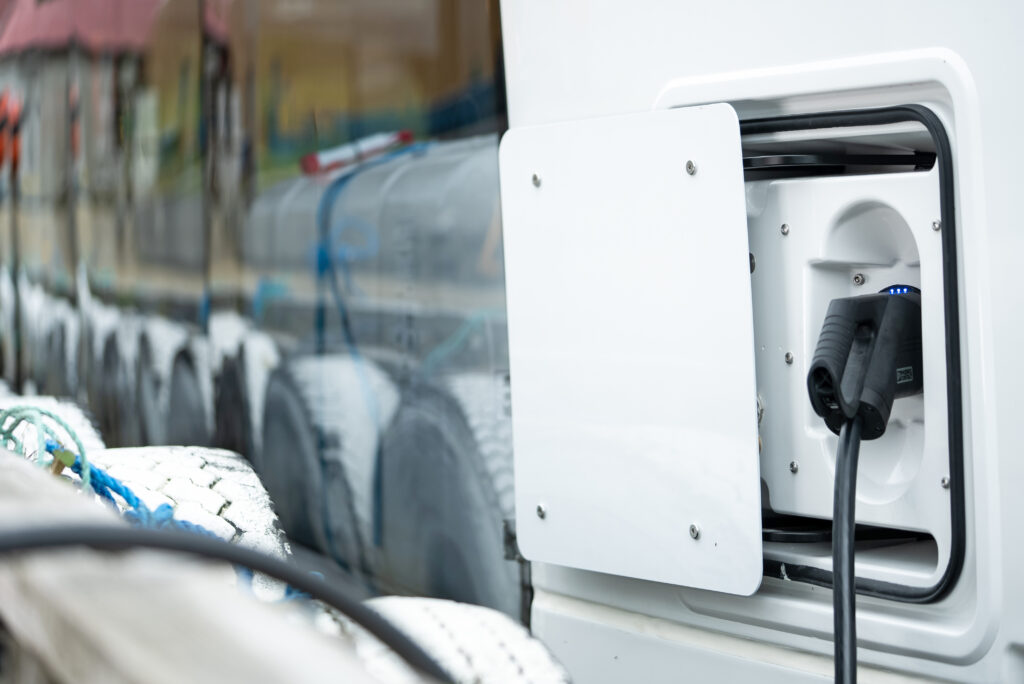
Renewable energy powers electric ferries through a straightforward chain: clean electricity is generated, stored in the vessel’s batteries, and converted into propulsion by an electric motor. The “renewable” part happens upstream, at the point of generation. When the electricity feeding a ferry’s charger comes from hydro, wind, or solar, the whole journey becomes zero-emission effectively at the point of use.
A working example makes this concrete. At Alcatraz in San Francisco, the US National Park Service reports that fast chargers let each ferry recharge between runs while passengers board, making it possible to power the boats on renewable electricity alone. The vessel carries no fuel and produces no exhaust; the clean energy is delivered dockside.
This is the core mechanic behind renewable energy ferry electrification: the ferry is a battery on a fixed route, and the route’s terminals become charging points fed by clean power. For a city like Venice, that means the environmental benefit depends as much on the electricity source as on the boat itself.
The fixed-route advantage
Scheduled ferries are almost ideally suited to clean charging. Because a waterbus follows the same route on a known timetable, its energy demand is predictable, and chargers can be sized and sited to top up the batteries during the brief stops when passengers board and disembark. That predictability is exactly what makes it possible to match a ferry’s charging to periods of abundant solar or wind, or to draw from stored renewable energy at the terminal. A private motorboat wandering the lagoon cannot offer that; a public shuttle on a set line can.
Can solar and wind power ferry charging stations?
Yes, solar and wind can power ferry charging stations, either directly or through the grid, and the evidence is growing. A peer-reviewed study of an island energy system found that photovoltaic generation could produce enough electricity to cover both the island’s own needs and a fully electric ferry service, while cutting annual system costs by more than 30% compared with diesel.
Solar and wind-powered ferry charging can be arranged in a few ways. Onboard rooftop panels supplement the batteries during daylight. Shore-side solar canopies and nearby wind capacity feed the terminal charger. And where local generation dips, a grid connection fills the gap.
Analysis of port electrification points the same direction: pairing offshore wind with port-adjacent solar, backed by battery storage, can supply the rapid dockside charging that ferries need during short turnarounds. For Venice, solar and wind-powered ferry charging would not need to sit inside the historic centre. Generation can be located where space allows, and the electricity delivered to the pontoons.
Onboard solar plays a supporting role rather than a starring one. Rooftop panels on a vessel cannot fully power propulsion on their own, but they can extend range, ease the load on the batteries during daylight, and cut how often the ferry needs to draw from shore. Combined with a battery buffer at the terminal, this lets an operator lean on stored clean energy at peak times and pull from the grid only when it has to, a practical way to keep charging both reliable and low-carbon.
Why renewable energy ferry electrification suits a city built on water
Renewable energy ferry electrification answers several of Venice’s problems at once. Clean electric vessels produce no exhaust at the point of use, which keeps hydrocarbons out of the canals and air. They run quietly, reducing the noise that motorboats push through the historic centre. And crucially, electric drivetrains produce almost no wake while idling, the exact condition that damages foundations when combustion boats sit and rumble at crossings.
Less wake, less damage
Because much of Venice’s structural harm comes from repeated wave action, a fleet that generates minimal wake at low speed addresses the erosion problem directly, not just the emissions one. This is a benefit combustion vessels cannot match.
A quieter, cleaner lagoon
Quieter operation and cleaner water also matter for the lagoon ecosystem and for residents. Replacing diesel operation with battery-electric propulsion removes the local pollutants that combustion engines emit continuously. Zero-emission electric ferries can ease pressure on the busiest routes and reduce congestion on the water in the same way electric ferry networks relieve strain on urban bridges and roads elsewhere.
The ferry electrification challenges Venice would need to solve
Ferry electrification challenges are real, and it helps to name them plainly. The vessel is the visible part; the harder work is often onshore.
Grid and charging. Battery-electric ferries need high-power charging at terminals, which can mean grid upgrades, transformers, and careful scheduling around dwell time. Independent reporting notes that upfront investment in charging infrastructure and grid capacity is the main barrier, especially where the local grid is constrained.
Cost and coordination. The initial outlay is significant, and it requires the operator, the utility, and the city to plan together. Smart charging during off-peak hours and shore-side battery buffers can reduce grid strain and spread demand more evenly.
Heritage constraints. Venice adds its own layer: any dockside equipment must sit within a UNESCO-protected setting. This is a design and planning problem, not a technical dead end. The charging can be sited discreetly, and the ferries themselves are well suited to short, fixed routes. In fact, ferries are electrifying earlier than most vessel types precisely because their predictable schedules fit charging infrastructure so well.
A practical path for renewable energy ferry electrification in canal cities
The momentum is not hypothetical. Independent reporting indicates that around 70% of newly ordered ferries worldwide are now electric or hybrid, driven largely by European regulation and the suitability of short routes. Canal and waterway cities are strong candidates because their routes are short, fixed, and close to shore power, the ideal conditions for renewable energy ferry electrification.
This is where a purpose-built approach helps. Hyke designs zero-emission passenger shuttles with solar integration and fast charging intended for exactly these urban-waterway conditions, and its urban mobility solutions are built around adding a clean layer of transport to waterways cities already have. Venice’s closest parallel may be another canal city: the same logic behind sustainable water transport in Utrecht applies directly to the lagoon.
Conclusion
Venice’s canal congestion, wake erosion, and boat emissions come from one shared source: a dense fleet of combustion vessels in fragile channels. Renewable energy ferry electrification offers a practical response: quieter boats, no exhaust at the point of use, minimal wake at idle, and charging that can be fed by solar, wind, or a clean grid. The challenges are mostly onshore: grid capacity, charging infrastructure, and heritage-sensitive siting. All are solvable with careful planning.
Hyke’s electric ferry solution is designed for precisely these urban-waterway conditions, from solar-integrated vessels to fast charging built for short, fixed routes. For a city that has always moved by water, the sensible next step is to assess a single high-traffic route and scope a pilot.