

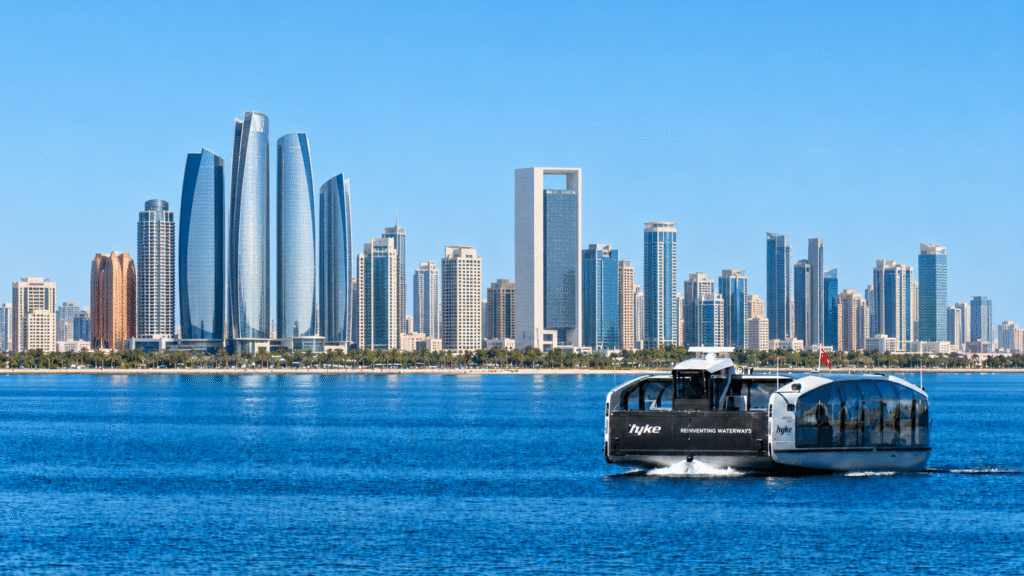
Yas Island is one of the busiest leisure destinations in the Gulf, and it is still growing. Theme parks, hotels, an arena, a marina and a Formula 1 circuit sit within a few kilometres of each other, yet most visitors move between them by car, taxi or coach, on roads that fill quickly on event nights. The water is already there: Yas Bay, the creeks around Al Raha Beach and the channels that run past the island’s attractions. A water taxi in Abu Dhabi already uses part of it, and the case for expanding that service on battery-electric vessels grows stronger with every new attraction. Cities elsewhere are finding that well-planned ferry links can ease pressure on bridges and road networks, and Abu Dhabi’s waterfront is a natural place to apply that thinking. This article looks at how water taxis work, what changes when they go electric, where the planned Disney resort fits, and why a compact, efficient vessel such as Hyke’s F-15 Shuttle is well suited to the short waterfront journeys Abu Dhabi needs.
Yas Island’s growth is outpacing the road
The numbers explain the pressure. Miral reported more than 38 million visits to Yas Island in 2024, a 10% rise on the previous year, with theme park visits up around a fifth. Miral also reported that hotel occupancy on the island averaged 82% across the year and peaked at 90% in August, and Abu Dhabi’s Tourism Strategy 2030 targets 39.3 million visitors a year.
Land transport is expanding to match. Abu Dhabi Transport Company has unveiled Line 4 of the Abu Dhabi Tram, a light rail project approved by the Department of Municipalities and Transport. Its first phase will link Zayed International Airport with Yas Island and the Al Raha Beach residential areas, with operations targeted for 2030. That is a strong backbone, but trams and roads cannot reach every waterfront hotel, marina and attraction directly. A more extensive water taxi in Abu Dhabi, running short and frequent links, can fill those gaps and give visitors a quicker, more memorable way to move around.
The water taxi in Abu Dhabi today: a foundation to build on
Abu Dhabi is not starting from scratch. Abu Dhabi Maritime launched a public water taxi service in November 2022 with Miral, following a water shuttle pilot earlier that year, connecting Yas Bay, Yas Marina and Al Bandar, with further stops to follow. The service was designed to run seven days a week with a vessel calling at each stop every hour.
The Yas Bay water taxi was designed to grow from the start, with Abu Dhabi Maritime signalling further stops beyond its first three and describing the service as one step in a long-term strategy for public water transport. The existing water taxi in Abu Dhabi therefore proves demand and gives the city operating experience; the next question is how far, how often and on what kind of vessel it should run.
How do water taxis work, and what changes when they go electric?
A water taxi is a small passenger vessel that runs between fixed stops, either on a timetable or on demand. Trips are short, often a few minutes, and boarding happens at simple pontoons rather than full ferry terminals. That makes water taxis well suited to waterfront districts where destinations sit close together but are separated by creeks, marinas or busy roads.
An electric water taxi keeps the same model but replaces the diesel engine with batteries and an electric motor. The vessel charges at its pontoon between trips or overnight, produces no exhaust while operating and runs far more quietly. Beside restaurants, hotel terraces and promenades like those at Yas Bay, the absence of engine noise and fumes is a genuine improvement to the guest experience, not just an environmental one.
Electric passenger vessels of this size are already in regular public service in Northern Europe, where operators report lower energy use and high passenger satisfaction. For an electric water taxi in the Gulf, an air-conditioned cabin and rooftop solar panels help manage heat and support onboard systems.
Where is Disney in Abu Dhabi, and how will visitors get there by water?
Disney’s Abu Dhabi resort will be on Yas Island. Disney and Miral announced the project in May 2025 as a waterfront resort, with Miral financing, building and operating it, and it is expected to sit alongside SeaWorld, Ferrari World, Warner Bros. World and Yas Waterworld. Photos shared by Disney’s chief executive from a site visit in January 2026 offered the clearest indication yet of its waterfront location, though no opening date has been confirmed. Disney has said a project of this scale typically takes one to two years to design and four to six years to build.
How visitors will reach it has not been announced. That leaves room to plan early, and the water is an obvious candidate. A waterfront resort a short boat ride from Yas Bay’s hotels, the Al Raha communities and the island’s marinas could be served by frequent shuttles, with Abu Dhabi’s water taxis complementing the planned Line 4 tram and road access. An electric water taxi network sized for theme park peaks would need several vessels, well-placed pontoons and charging built in from the start, which is precisely why the conversation is worth having now rather than after the gates open.
Where a water taxi route in Abu Dhabi could make a difference
Abu Dhabi’s waterfront is full of short but awkward trips: places a few hundred metres apart across a creek or canal, yet much further apart by road. A few examples show where compact electric vessels could help. None of these is an existing or planned service, and each would depend on route surveys, berth availability and approval from the relevant authorities.
Yas Island. A cross-creek hop of around three minutes could link Al Bandar Marina and the Al Muneera communities with Yas Bay’s hotels, restaurants and events, extending the existing Yas Bay water taxi idea. A longer link of around a quarter of an hour could reach a gateway near SeaWorld, Yas Mall and Ferrari World.
Ramhan Island. A flexible multi-stop shuttle could connect waterfront homes with the marina, hotels, dining and wellness facilities, growing with each development phase.
Grand Canal to Al Qana. A water taxi route in Abu Dhabi along the Grand Canal could carry guests from the hotels near Qaryat Al Beri to Al Qana and The National Aquarium in around 12 minutes.
Cruise terminal to Louvre Abu Dhabi. A transfer of about seven minutes from Zayed Port to Saadiyat Island would give cruise passengers more time at the museum and fewer coach journeys, the kind of cleaner port link seen in port electrification in Barcelona.
What these journeys share is a clear profile: short distances, sheltered water, frequent departures and a mix of residents, hotel guests and visitors.
Why Hyke’s F-15 Shuttle suits Abu Dhabi’s waterfront
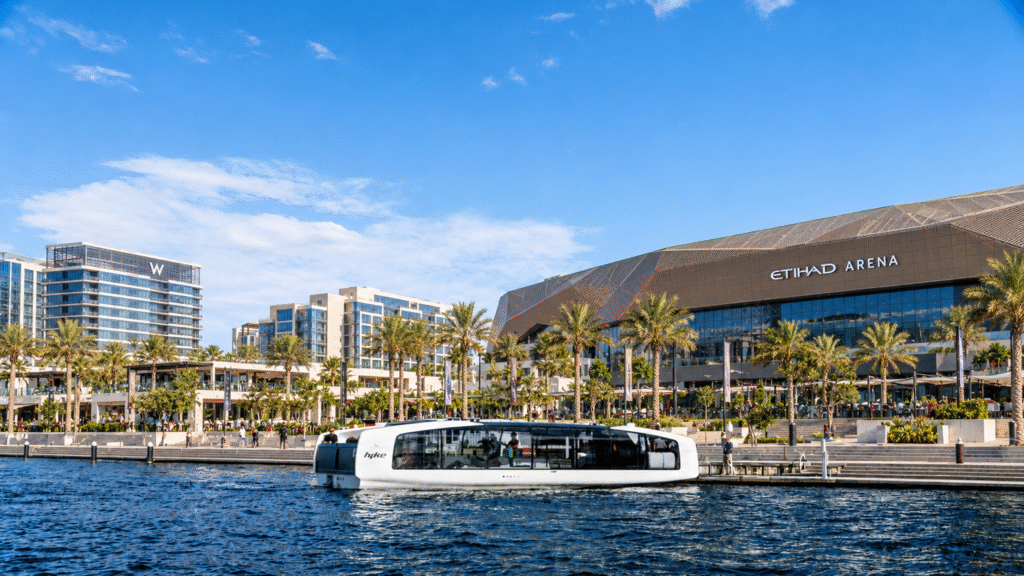
That profile is exactly what the Hyke F-15 Shuttle was designed for. Developed in Norway for short urban crossings in sheltered water, it has already proved itself in daily public transport: during a 14-month trial in Fredrikstad, it carried more than 41,000 passengers and used up to 88% less energy than comparable diesel vessels, according to the municipality’s report, with no safety incidents recorded and high passenger satisfaction.
Right-sized for marinas and canals. At 14.9 metres long, with a draft of around one metre, the F-15 is compact enough for marina berths, hotel pontoons and canal landings that larger ferries cannot reach. It carries around 50 passengers in its standard public-transport layout, which suits frequent shuttles rather than occasional bulk transfers, and propulsion pods at the bow and stern help it manoeuvre and berth precisely in tight spaces.
Very low energy use. At service speed, the F-15 draws roughly as much power as five household hair dryers. For a service that may run from morning commutes to late-night events, that efficiency keeps operating costs low.
Simple charging. The vessel charges from a standard CCS2 electric-vehicle fast charger at up to 150 kW in under an hour, or overnight from a 22 kW AC supply. Pontoons at hotels, marinas and attractions can therefore be equipped without the specialised high-power infrastructure that larger electric ferries need, and optional integrated solar panels can reduce the energy drawn from shore.
One vessel, many roles. The open, step-free interior can be configured around the operation: a commuter layout for residents’ shuttles, an executive layout for up to 24 guests, or a lounge for tourism, events and private charters, with options such as toilets, storage or a small bar. The same platform could run scheduled shuttles by day and carry guests to concerts, Formula 1 weekends or hotel functions by night. Quiet electric propulsion and wide windows also protect the waterfront atmosphere that hotels and attractions invest in.
Ready for what comes next. The F-15 is autonomy-ready and can be equipped with systems supporting increasing levels of automation, giving operators a path to more frequent services over time where regulations allow. Final capacity, configuration and charging arrangements for any Abu Dhabi application would depend on local regulations and a route assessment.
Building the water taxi in Abu Dhabi into a connected network
Expanding the service from a set of hops into a network depends on practical groundwork. Pontoons need reliable charging, ideally drawing on shore power infrastructure that can handle quick top-ups between trips. Timetables should flex around major events, and ticketing should connect with buses and, once it opens, the Line 4 tram, so that each water taxi route in Abu Dhabi becomes one leg of a longer journey rather than a stand-alone attraction.
Shade, accessibility and clear wayfinding at each stop matter just as much as the vessels themselves. Abu Dhabi Maritime’s regulatory role, berth planning with developers and early coordination with large projects such as the Disney resort would all shape how quickly a network can grow.
Conclusion
Yas Island’s visitor numbers are rising, a major new resort is on the way, and the island is surrounded by sheltered water that already carries passengers. The water taxi in Abu Dhabi has shown that residents and visitors will use the water; battery-electric vessels can make that service quieter, cleaner and more comfortable, while short, well-planned routes connect homes, hotels, attractions and the cruise terminal.
The capital’s water taxis could become a dependable part of how people move around the waterfront, and the vessel choice matters. Hyke’s F-15 Shuttle brings together what this kind of service needs: a compact hull sized for marinas and canals, very low energy use, charging from standard EV equipment and an interior that adapts from commuter shuttle to hospitality lounge. Drawing on that operating experience in Norway, Hyke’s urban mobility solutions are designed for exactly this kind of short-route, high-frequency service. For authorities, operators and developers weighing the opportunity, a sensible next step is to assess one or two priority routes, survey berths and charging, and scope a pilot that can grow alongside the island.