

Maritime transport moves the vast majority of world trade, and it does so while accounting for a significant share of global greenhouse gas emissions. For ports and cities, that is no longer an abstract statistic. It is a planning problem with deadlines attached, set by the International Maritime Organisation, the European Union, and national climate targets. Increasingly, the response is taking shape through green shipping corridors, and at the Port of Antwerp-Bruges, that approach is already in motion, with electric ferries helping drive EU Green Deal goals alongside it.
The difficulty is that no single operator can decarbonise a shipping route alone. A cleaner vessel needs cleaner fuel or charging at both ends, terminals equipped to supply it, and regulations that make the economics work. Change has to happen across the whole route at once.
This is the thinking behind green shipping corridors, and it is closely tied to the rise of electric ferry networks across Europe. The Port of Antwerp-Bruges has become one of the clearest examples of the model in action. This post explains what a green shipping corridor is, how Antwerp-Bruges is using the approach to decarbonise, and how electric ferry networks are turning corridor ambition into everyday emission reductions.
The decarbonisation challenge maritime transport can’t avoid
Shipping is efficient per tonne of cargo, but its absolute emissions are large and concentrated around ports. Coastal cities feel this directly through air quality, noise, and the carbon footprint of the freight and passenger traffic that passes through them.
Regulation is tightening the timeline. The EU has brought shipping into its Emissions Trading System, which turns carbon into a rising operating cost, and national targets are pushing operators toward cleaner vessels and fuels well before 2050.
Why coordinated routes, not single ships, are the unit of change
The practical obstacle is coordination. A zero-emission vessel is only useful if the infrastructure it depends on exists where it docks. That means charging or bunkering, grid capacity, and terminal upgrades all have to arrive together.
Tackling one route at a time, with every stakeholder involved, is far more tractable than trying to decarbonise an entire fleet in the abstract. The route becomes the unit of change. That is exactly what a green shipping corridor sets out to organise.
What is a green shipping corridor?
A green shipping corridor is a specific maritime route between two or more ports where zero- or near-zero-emission shipping is deployed through coordinated public and private action. Rather than leaving decarbonisation to individual operators, a corridor aligns ports, vessel owners, fuel suppliers and regulators around one shared route.
The concept comes from the Clydebank Declaration, launched at COP26, in which signatory countries committed to establishing zero-emission shipping routes between ports. Definitions vary slightly between organisations, but the shared intent is consistent: concentrate effort and investment on defined routes so that clean technology becomes viable faster than it would across the fleet as a whole.
The practical value is that a corridor solves the coordination problem deliberately. When people ask what a green shipping corridor is, the most useful answer is that it is a route where zero-emission solutions are demonstrated and supported by everyone who touches it: not a single ship, but the whole system around it.
That system-level focus is what makes the model relevant to ports trying to decarbonise at scale.
Green shipping corridors in Antwerp: how Port of Antwerp-Bruges is decarbonising
Few ports illustrate the corridor approach as clearly as Antwerp-Bruges. As one of Europe’s largest import, export, and bunkering hubs, it has both the emissions challenge and the influence to do something about it at the route level.
The Sweden-Belgium corridor
In 2024, the Port of Antwerp-Bruges joined the Sweden-Belgium green shipping corridor alongside the Port of Gothenburg, North Sea Port, and operator DFDS. The partners aim to run low- and near-zero-emission vessels on the route from 2030, supported by electrified terminal operations, onshore power supply and alternative-fuel bunkering.
What makes this a corridor rather than a single project is its breadth. It spans roughly 2,500 kilometres of sea, land and rail links, and treats the ports as both transport hubs and origin-and-destination points. Decarbonising it means coordinating vessels, terminals, and land transport together: the corridor logic applied end to end.
Shore power, electrification, and the road to 2050
The corridor sits inside a wider strategy. The Port of Antwerp-Bruges is aiming for climate neutrality by 2050, with green shipping corridors as one pillar among several.
Shore power is central to that work. The port has committed to making best efforts to deploy shore-side electricity supply for seagoing vessels by 2028, allowing docked ships to draw electricity from the grid instead of running auxiliary engines, the same principle behind onshore power supply for docked vessels at any electrified terminal. The lesson from Antwerp is that port electrification and corridor partnerships reinforce each other: the same shore-side infrastructure that supports a freight corridor also supports cleaner passenger vessels, an approach mirrored in port electrification efforts in Barcelona.
For other ports, Antwerp-Bruges offers a template: pick defined routes, build the infrastructure that serves more than one purpose, and align partners around shared deadlines.
The rise of electric ferry networks in Europe
Corridors set the strategic frame for long-distance freight. For shorter passenger and commuter routes, the same coordinated thinking is producing something more immediate: electric ferry networks. Across the electric ferry network Europe is building, the pattern is consistent: fixed routes, frequent sailings, and terminals equipped to charge vessels between trips.
What an electric ferry boat brings to a network
An electric ferry boat is well-suited to scheduled, repeating routes precisely because those routes are predictable. The vessel returns to the same terminals at known intervals, so charging can be planned rather than improvised.
The benefits compound at the network level. Beyond eliminating local exhaust emissions, electric vessels run more quietly and with lower energy use, and their operating and maintenance costs are typically lower than those of diesel equivalents. When several routes share charging infrastructure and renewable supply, those advantages scale across the whole network rather than one boat at a time.
Norway’s networks as the proof of concept
Norway shows what maturity looks like. The country operates the most electric ferries of any nation, the result of sustained policy support, subsidies, and charging infrastructure built out over a decade.
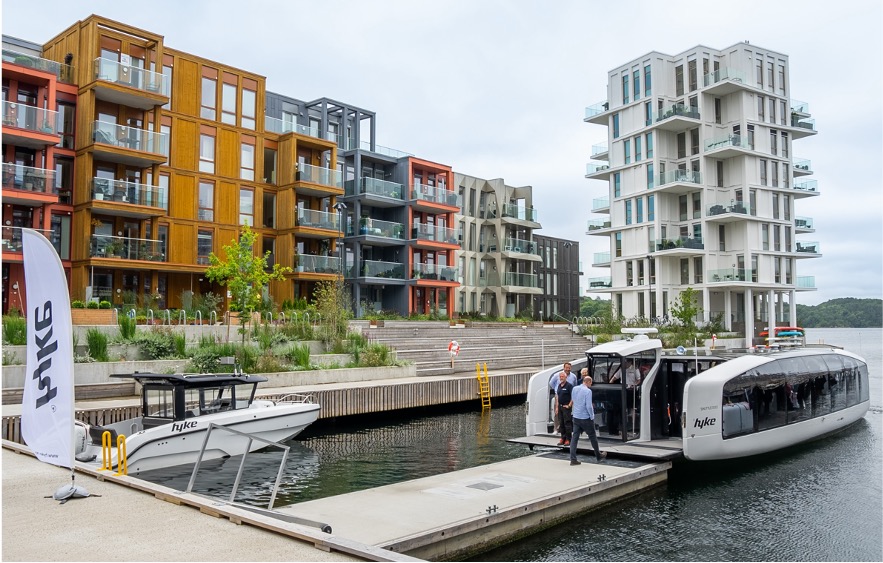
The scale is now substantial. By early 2026, more than 100 electric cars and passenger ferries were in service in Norway, including the world’s first fully electric passenger ferry and the world’s first fully electric high-speed ferry. Norwegian innovators have been central to this, including Hyke, which designs autonomy-ready electric ferries with integrated solar panels for urban and inland waterways. The country’s experience, explored further in how Norway’s electric ferries connect to its renewable energy goals, demonstrates that electric networks are operationally and economically feasible at scale.
How are electric ferry networks reducing emissions?
Electric ferry networks reduce emissions in two reinforcing ways: by removing the direct emissions of each diesel vessel they replace, and by making clean operation the default across an entire route system rather than a one-off pilot.
The single-vessel impact is already measurable. Norway’s MS Medstraum, the world’s first fully electric fast ferry, cuts roughly 1,500 tonnes of CO₂ a year on a commuter route near Stavanger, the equivalent of taking dozens of buses off the road, while using around 30% less energy than a conventional fast ferry. That is one vessel on one route, replacing one diesel service.
The network effect multiplies it. When a region electrifies many routes and shares charging and renewable supply, every additional vessel adds to the total reduction and strengthens the case for the next. Analysis of Europe’s fleet suggests the headroom is large: by 2035, up to around half of Europe’s ferries could be viable as battery-electric vessels, with more suitable as hybrids.
Crucially, the emission savings are only as clean as the electricity behind them. A network charged from renewable power delivers genuine reductions; one charged from fossil generation simply moves the emissions elsewhere. This is why corridor-style coordination, pairing vessels with clean, grid-connected charging, matters so much.
From corridors to everyday networks: where ports and cities go next
The connection between green shipping corridors and electric ferry networks is not incidental. Both rest on the same principle: decarbonise a defined route by aligning vessels, terminals, and energy supply, then scale the model outward.
For ports, the freight corridor and the passenger network can share infrastructure. Shore power installed for a green corridor can charge electric ferries; grid upgrades made for one serve the other. For cities, electric ferry networks add clean capacity on waterways that already exist, easing pressure on roads while meeting climate targets. This is the foundation of broader electric ferries for smart urban mobility.
A practical next step
The sensible move for a port authority or municipality is to identify a candidate route and assess it concretely: the energy a route demands, the terminal charging required, the renewable supply available, and the partners needed to make it work. That assessment turns corridor ambition into a deployable plan: the same disciplined, route-level approach that has worked for both freight corridors and ferry networks.
Conclusion
Green shipping corridors and electric ferry networks are two expressions of the same idea: that the route, not the individual ship, is where maritime decarbonisation becomes practical. The Port of Antwerp-Bruges shows how a major hub builds corridors and shore-side electrification together, while Europe’s electric ferry networks show the model delivering measurable emission cuts today.
Three points stand out. Corridors solve the coordination problem that stops single operators from decarbonising. Electric ferry networks turn that coordination into everyday, scalable emission reductions. And the savings are only as clean as the energy behind them, which makes renewable-powered charging essential.